

//Case Studies/Smart Heating

Challenge

Chronically excessive setpoint temperatures and energy consumption due to unregulated, inefficient building heating systems and the resulting CO₂ emissions

Solution

LoRaWAN-enabled sensors, digital heating curve control, and a central dashboard for visualization

Highlights

  • 300 square meters of office space
  • 17,500 kWh and 14 tons of CO₂ saved per year
  • 2 weeks from kick-off to go-live

Starting Point

In a 300-square-meter office building owned by CURRENTA, the heating system was running at a high setting regardless of actual room usage or the outside temperature. This was due to a lack of transparency regarding room usage, air quality, and energy consumption.

Challenged problems

  • No demand-based control
    The heaters ran continuously at 22–24 °C—regardless of the time of day, the weather, or whether anyone was home.
  • No indoor air quality monitoring
    Neither temperature trends nor CO₂ or particulate matter levels were recorded or analyzed.
  • High energy consumption, no concern for CO₂ emissions
    Large amounts of heating energy each year resulted in several tons of CO₂—with no way to optimize or reduce it.
  • Flat-rate billing
    Because of the flat-rate billing, more heat was used than necessary, and the potential for savings went unnoticed.

Solution

Achieve sustainability goals through heating optimization and air quality tracking in just two weeks.
  • Retrofitting with smart heating actuators
    16 actuators regulate the heating according to demand—based on temperature, occupancy, and time profiles.
  • Sensors for CO₂, temperature, and particulate matter
    Eight networked air quality sensors provide precise data for greater comfort, a better indoor climate, and targeted ventilation.
  • Dashboard for Transparency and Control
    A central dashboard displays temperature trends, operating hours, energy consumption, and CO₂ levels for the 300-square-meter office space.
  • Efficient data transmission via LoRaWAN
    The integration of existing infrastructure (Conneqtive) enables secure and scalable connectivity—even for future buildings.
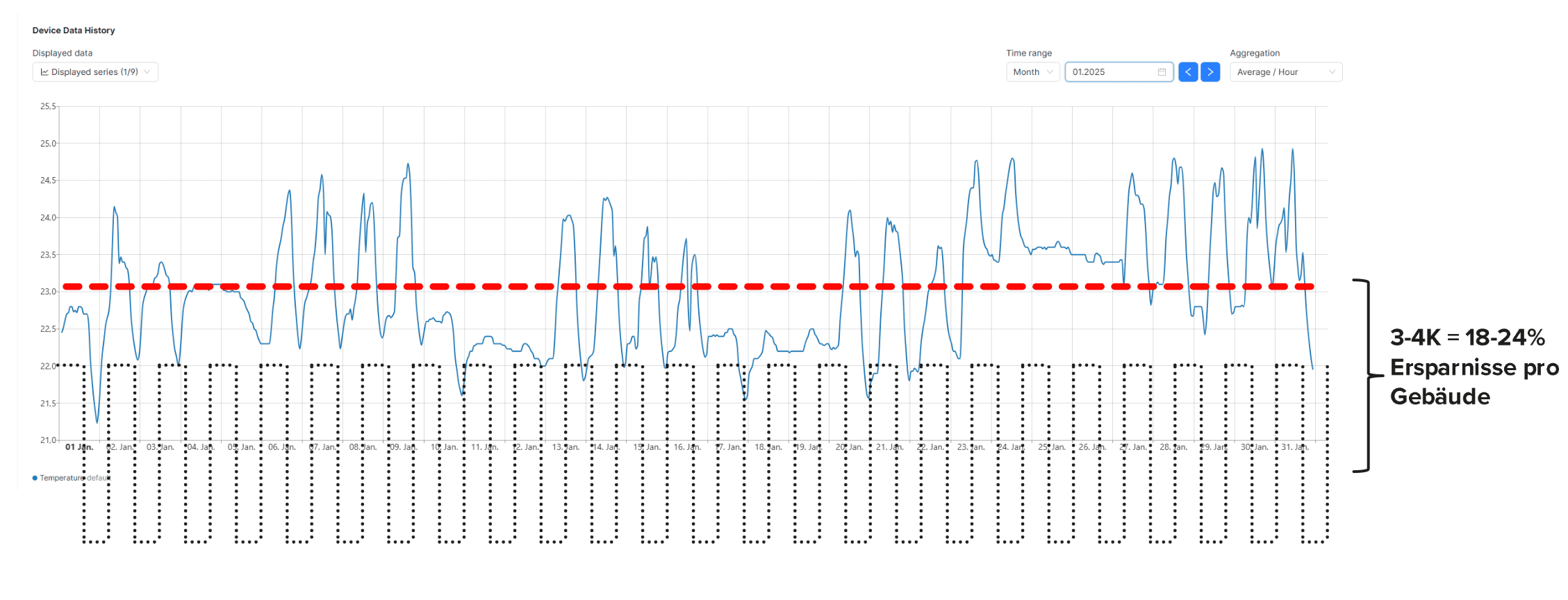
Chart of Daytime and Nighttime Temperatures Over the Course of a Month

Outcome

  • An average temperature drop of 3–4°C, from 23–24° to 20°
  • Energy consumption is expected to be 30% lower thanks to intelligent control
  • A measurable contribution to achieving ESG and sustainability goals

Are you facing a similar situation?

Together, we'll tailor the application to your needs.

Murat MutluMurat Mutlu, Solution Portfolio Manager

Start a request

Used Services

IT Infrastuctures

IoT Solutions

Related Case Studies