/…/Newsroom/Predictive Maintenance in Practice: How Data-Driven Maintenance Drastically Reduces Unplanned Downtime
Blog Post ·
Predictive Maintenance in Practice: How Data-Driven Maintenance Drastically Reduces Unplanned Downtime
Unplanned downtime is one of the most costly risks in industrial operations. Especially where continuous processes, safety-critical systems, and strict delivery commitments intersect, outages are more than just a technical problem—they quickly become a strategic risk.
Predictive maintenance has been considered a solution for years. But there’s often a gap between theory and practice.
Many decision-makers ask themselves: “Does this really work during ongoing operations? In existing plants? Under real-world industrial conditions?"
A recent case study from CHEMPARK provides reliable answers to these questions and shows how data-driven maintenance not only improves processes but also changes the way people think about operations.
Beyond Maintenance "Flying Blind": Why Traditional Maintenance Is Reaching Its Limits
In many industrial facilities, maintenance still follows fixed intervals. Pumps, motors, and compressors are inspected—regardless of whether they show any signs of trouble. This approach conveys a sense of security but creates a dangerous situation of flying blind.
Without continuous condition data, early signs of wear remain hidden. Damage is often not detected until anomalies have already reached a critical stage. The consequences are:
unplanned downtime
expensive emergency repairs
long lead times for specialty components
It was precisely against this backdrop that CHEMPARK reframed the question: "What if maintenance were based not on assumptions, but on real-time data?"
Case Study Overview: Predictive Maintenance at CHEMPARK
The following case study documents a real-world project for condition monitoring of high-performance pumps in a chemical industrial setting. It illustrates not only the technical implementation but, above all, the operational benefits of predictive maintenance.
Quick Overview for Decision-Makers
Category
Summary
Industry / Environment
Chemical Industrial Park (critical infrastructure)
From Reacting to Taking Action: The Success Story Behind the Numbers
Initial Situation: Reactive Maintenance as a Risk
In the plant section under review, those in charge operated a large number of rotating machines. Despite regular inspections, unplanned outages occurred time and again. The condition of the pumps was known—but only on a case-by-case basis. Looking back, one person involved summarizes the situation as follows:
“We knew outages were coming—but not when. That made planning nearly impossible.”
The Turning Point: Condition Data Instead of Empirical Values
The decisive step was not to further optimize maintenance, but to change the approach. Instead of fixed intervals, condition data was continuously collected. Vibrations and temperatures provided early indications of deviations from normal operation.
The goal here was not maximum data depth, but the ability to act early. Anomalies were to be detected before they escalated into damage.
Implementation in a nutshell: Retrofit instead of new construction
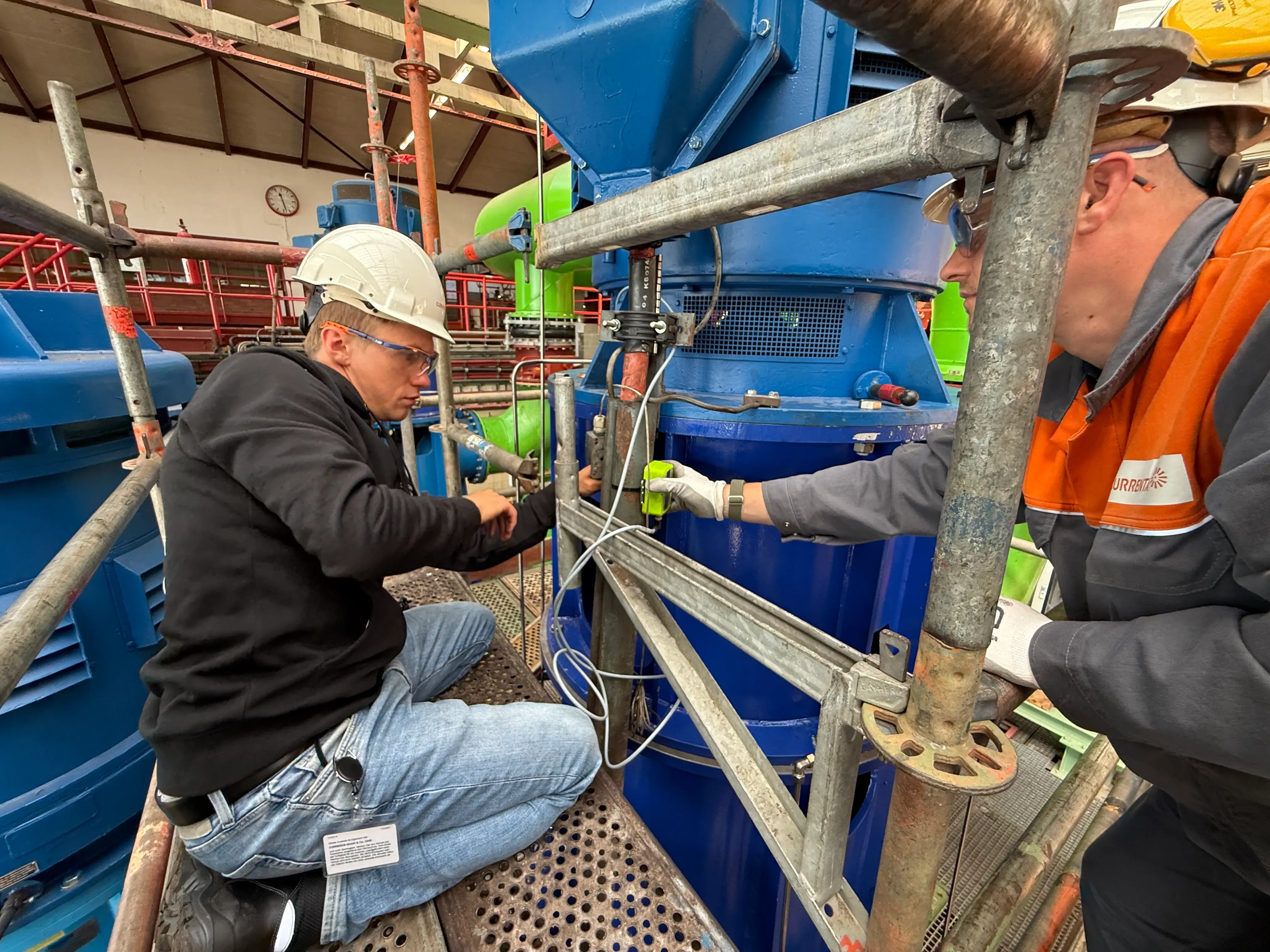
A key success factor was the decision to pursue a retrofit scenario. Existing pumps were retrofitted with industrial-grade sensors—without disrupting ongoing operations. Data was transmitted wirelessly via LoRaWAN®. A central IoT platform aggregated the information, visualized trends, and automated notifications when thresholds were exceeded. The result: Live data was available within a few weeks. Operations did not need to be restructured, but simply reimagined.
What really made the difference—the results
The solution’s impact was clearly measurable:
70% fewer unplanned downtimes Unexpected downtime was virtually eliminated.
99% faster response time to anomalies Minutes instead of days between detection and action.
30% longer service life for critical components Early intervention prevented consequential damage.
These figures are not theoretical targets, but were achieved in real-world operations.
Condensate management is a fundamental technical and economic requirement for any efficient steam system and can be fully automated.
Murat Mutlu, Solution Portfolio Manager, Conneqtive
Lessons Learned from Implementation
Several overarching insights can be drawn from the case study:
1. Early detection is more cost-effective than perfection
The goal is not to analyze every detail, but to identify relevant deviations early on. Time is saved not by collecting more data, but by making better decisions.
2. Retrofitting is the realistic starting point
Predictive maintenance is not exclusive to new facilities. Existing plants can also be made data-capable with manageable effort.
3. Platforms Accelerate Time to Value
Using an existing IoT platform drastically shortens implementation times and reduces project risks.
What matters is not the specific use case, but the combination of sensor technology, connectivity, and clear decision-making rules.
Context: Why This Case Study Is More Than Just a Single Project
What makes this case study particularly valuable is not just the result, but its context. It shows that predictive maintenance is no longer an experiment, but a robust operating model—when implemented pragmatically.
The real added value arises when such projects are not viewed in isolation, but are used as a blueprint for further use cases.
Conclusion
This case study provides reliable answers to one of the central questions of industrial digitalization: “Does predictive maintenance really work in everyday practice?” Yes, when technology, processes, and the vision align.