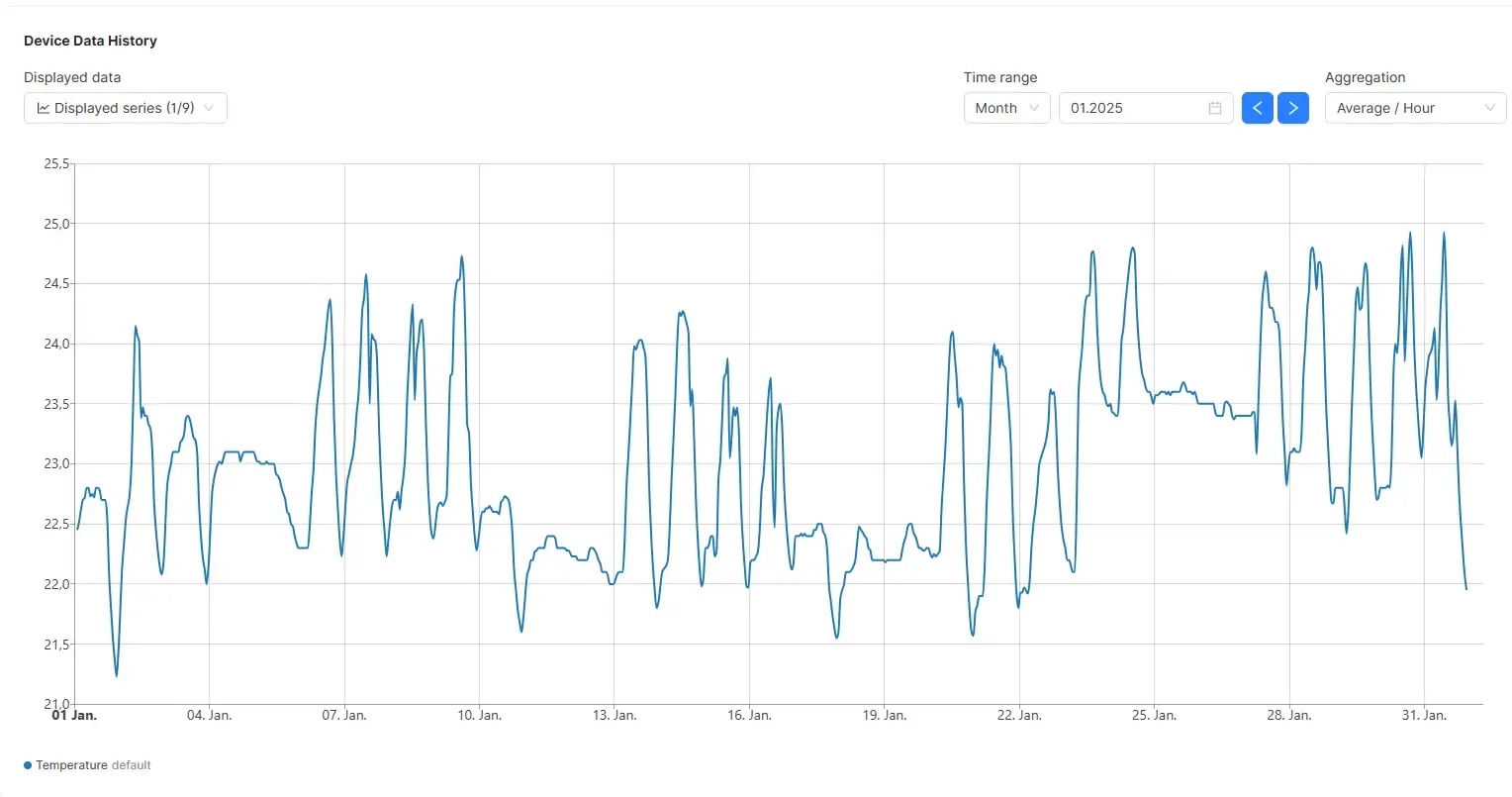
Energy and consumption data are key tools for industrial companies to reduce costs, streamline processes, and better manage sustainability goals. With IoT, consumption of electricity, heat, water, compressed air, and other utilities can be automatically recorded and transparently analyzed. This reveals where resources are being used and where savings opportunities lie.
In an era of increasing demands for energy efficiency, ESG, and cost control, this is a highly relevant use case. Energy and consumption monitoring with IoT combines technical data collection with business benefits and is therefore a sensible starting point or a quick way to expand existing IoT structures for many industrial companies.
What Energy and Consumption Monitoring with IoT Means
Energy and consumption monitoring describes the digital collection and analysis of consumption data in production, buildings, or locations. IoT makes this measurement continuous, automated, and comparable.
Automatically Collecting Consumption Data
Sensors and measurement systems record consumption without manual readings. This results in reliable and up-to-date data.
Centrally Analyzing Data
The values are consolidated and analyzed on a single platform. This reveals trends, peak loads, and anomalies.
Transparency Regarding Costs and Efficiency
Consumption data helps to understand operating costs and identify opportunities for optimization. This makes the solution attractive for management and controlling as well.
What Types of Consumption Can Be Monitored
Depending on the location and application, different energy and utility consumption metrics may be relevant.
Electricity consumption
Electricity consumption is often the most important starting point. It is easy to measure and is frequently directly linked to costs and efficiency.
Heating and cooling
In many industrial and building-related environments, thermal consumption is relevant. It affects operating costs and the carbon footprint.
Water and Other Media
Water, compressed air, and other media can also be monitored. This is particularly useful when consumption is relevant to operations or sustainability.
Site- and Area-Specific Consumption
Consumption data can be recorded not only centrally but also broken down by area, production line, or site. This enables comparability.
Why This Topic Is So Important for Companies
Energy and consumption monitoring has clear business and strategic relevance.
Controlling Costs
Knowing consumption data allows companies to better control costs and identify potential savings more effectively.
Improving efficiency
Transparency regarding consumption is often a prerequisite for identifying and optimizing inefficient processes.
Making sustainability measurable
Consumption data is a key foundation for ESG and sustainability goals. Without data, many aspects are difficult to substantiate.
Enabling Site Comparisons
Especially when there are multiple plants or sites, monitoring reveals where differences exist and where measures are warranted.
The benefits of IoT-based consumption monitoring
Automation instead of manual monitoring
Measurements are recorded continuously and automatically. This saves effort and improves data quality.
Early detection of anomalies
Load peaks, unusual consumption patterns, or undesirable trends become visible more quickly.
Basis for action
The data provides an objective basis for efficiency measures, investments, or internal analyses.
Better communication within the company
Consumption data makes efficiency and sustainability more understandable and tangible for various departments.
Where consumption monitoring is particularly useful
Production
Production areas often have high and complex energy consumption patterns. Transparency is especially valuable here.
Buildings and Infrastructure
Technical rooms, warehouses, and infrastructure areas also benefit from consumption transparency.
Multi-site Companies
When there are multiple plants, comparability provides additional benefits.
ESG and Sustainability Context
Consumption monitoring supports reporting, goal-setting, and internal management toward sustainability.
How Environmental Monitoring Differs
Environmental monitoring measures conditions
This involves temperature, humidity, air quality, and similar environmental parameters.
Consumption monitoring measures resource consumption
Here, the focus is on electricity, heat, water, and other utilities.
Both topics complement each other
In practice, they often go hand in hand, but should be treated separately in terms of content to avoid redundancy.
The role of the IoT system provider in this process
Defining measurement points and data flows
The system integrator helps determine appropriate measurement points and data paths.
Transforming consumption data into a usable format
The information must be visualized in an understandable way and translated into reports or actionable measures.
Considering scalability
A good partner ensures that the initial implementation at one location can later be scaled to other areas.
Questions Companies Should Clarify in Advance
Which consumption metrics are relevant?
Not every metric is equally important. The focus should be on data relevant to consumption and costs.
Who uses the data?
Energy, ESG, Controlling, Production, and Management often have different expectations.
How detailed should the measurements be?
The level of detail in data collection determines the effort and benefits.
How are actions derived?
Measurement alone is not enough. Clear processes for evaluation and implementation are needed.
Conclusion
Energy and consumption monitoring with IoT is a particularly valuable use case because it combines transparency, cost reduction, and sustainability goals. It is equally applicable to management and line departments and often delivers fast, measurable results.