Cloud architectures play an important role in industrial IoT whenever data needs to be processed centrally, scaled, and made usable across sites. They make it possible to consolidate information from machines, plants, and sensors in a flexible environment and to make it available for analysis, reporting, and operations.
In an industrial environment, however, the cloud is not an end in itself. It must be embedded in an overall architecture that takes availability, security, data location, operating model, and integration capability into account. That is why the cloud in industrial IoT is almost always part of a larger, often hybrid infrastructure.
What the cloud means in industrial IoT
The cloud in industrial IoT refers to the use of centralized, flexibly scalable IT resources for processing, storing, and analyzing machine data and operational information. Platforms, databases, analytics tools, and interfaces can all be operated in the cloud.
Centralized processing of IoT data
The cloud makes it possible to bring together data from many sources in one place. This is especially relevant when several sites, plants, or assets are to be integrated into a shared information model.
The cloud as a platform layer
In an industrial context, the cloud is often used as a platform for analysis, visualization, and higher-level control. It serves not only for storage, but also for processing and providing relevant data.
The cloud as part of an overall architecture
In industrial IoT, the cloud is rarely the sole solution. It complements local components such as edge systems, networks, and data centers, becoming part of a distributed architecture model.
When the cloud makes sense in industrial IoT
The cloud is particularly useful when centralized analysis, high scalability, or cross-site access are the main priorities.
For multiple sites
When data from different plants, branches, or production lines needs to be consolidated, the cloud offers clear advantages. Central platforms can be operated more consistently and expanded more easily.
When scalability is required
The cloud is especially well suited when the solution is meant to grow with the company. Additional data sources, new applications, or further users can usually be integrated more flexibly than in purely local systems.
For analytics and reporting applications
Many industrial IoT applications require analyses across multiple sources. The cloud provides the central infrastructure needed to consolidate, condense, and make use of this data.
For platform operations and service models
When IoT solutions are operated as a service or with managed services, the cloud is often a suitable technical foundation. It supports standardized operating models and simplifies maintenance and further development.
What benefits the cloud offers
The cloud brings several benefits to industrial IoT that become especially relevant as scope and complexity grow.
Centralized data availability
Data from different sources can be made available in a shared environment. This simplifies analysis, transparency, and company-wide use.
Flexibility and scaling
Cloud resources can often be adapted faster than purely local systems. This is helpful when projects grow or new requirements arise.
Simplified platform operations
Many operational tasks such as provisioning, maintenance, or expansion can be implemented in a more standardized way in cloud architectures. This can make operations more efficient.
A solid basis for cross-site use
The cloud makes it easier to provide data and applications consistently across multiple sites. This is particularly interesting for industrial organizations with distributed structures.
What challenges the cloud brings to industrial IoT
Despite its advantages, the cloud is not automatically the best solution for every industrial use case. It comes with requirements that must be considered early on.
Dependence on connectivity
Cloud architectures rely on stable connections between source and platform. If these connections are unreliable, usability can be limited.
Requirements for data location and governance
In industrial environments, where data is processed and stored is often important. Location, legal frameworks, and internal governance must therefore be clarified.
Security and integration questions
Cloud solutions must be integrated into existing IT and OT landscapes and secured accordingly. This concerns access models, segmentation, encryption, and monitoring.
Not every use case is cloud-first
Some use cases require local processing or very fast response times. In such cases, the cloud alone is not enough and must be complemented by edge or local components.
How cloud and edge work together
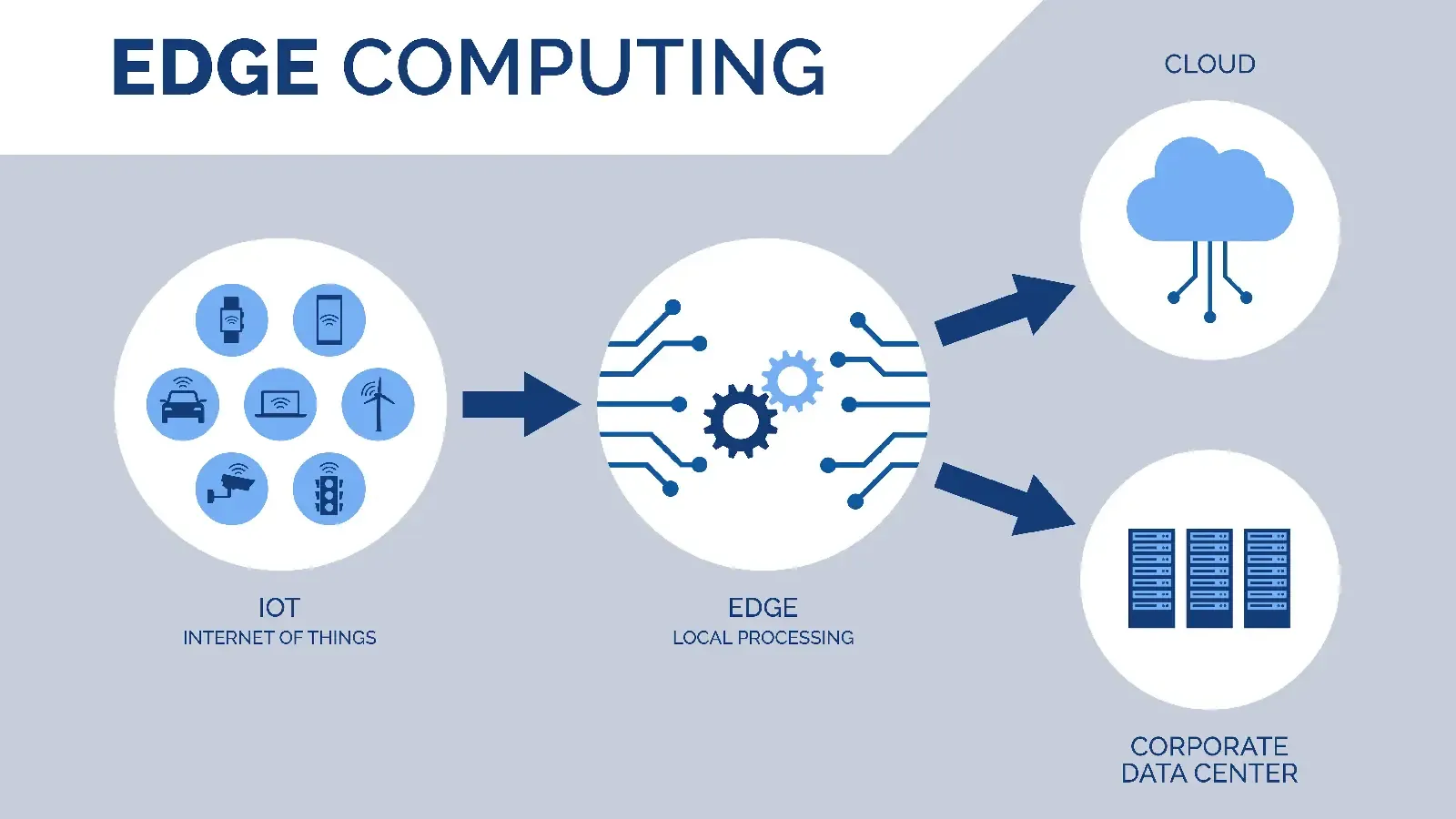
In industrial IoT, combining cloud and edge is often the most sensible architecture. Both approaches serve different functions and complement each other perfectly.
Edge for local tasks
Edge handles tasks that must take place directly at the machine or plant. These include preprocessing, filtering, and fast local responses.
Cloud for central tasks
The cloud handles central storage, analysis, cross-site evaluation, and overarching platform operations. It provides the place for consolidated information and standardized applications.
The hybrid architecture
Most industrial solutions benefit from a hybrid structure. Data is prepared locally and then processed further centrally. This makes it possible to combine response speed with scalability.
What role hosting and data centers play in the cloud context
Even when the cloud is the focus, the question of hosting and data centers remains important. Cloud services run on a physical infrastructure that affects availability, security, and location issues.
Infrastructure as the foundation of the cloud
The cloud is not an abstract layer; it is based on real computing and storage resources. Hosting and data centers therefore remain important factors for stability and trust.
Location and governance
For many companies, it is relevant where their data is processed and which standards apply. This matters above all for compliance, security, and approval processes.
Connection to operational and security requirements
The choice of a cloud architecture affects security, operations, and governance. It should therefore always be assessed in the overall context of the IoT infrastructure.
What role the IoT System House plays
An IoT System House helps you understand the cloud not as an isolated technology, but as part of an integrated industrial solution. It assesses how cloud, edge, hosting, and connectivity should work together.
Architecture instead of product logic
A good IoT System House does not think in terms of individual products, but in terms of architectural decisions. It examines which data should be processed locally and which centrally.
Operating models and scaling
The cloud can be an important building block for standardized operating models. The IoT System House helps design these models so that they fit the company and its industrial requirements.
Connecting IT, OT, and platform
The cloud only delivers sustainable results if it is cleanly integrated into the IT/OT landscape. This requires experience with industrial environments, security requirements, and operational processes.
What questions companies should clarify in advance
Before deciding on a cloud architecture, companies should answer a few key questions:
Which data should be processed centrally?
Not all data belongs in the cloud. It should be clear which information needs to be analyzed centrally and which must be preprocessed locally.
How demanding are the requirements for availability and response time?
Depending on the application, it may make sense to combine cloud with edge. The architecture must be guided by the business and technical requirements.
Which security and location requirements apply?
Cloud architectures must match the company's security level, governance, and any regulatory requirements.
How should the solution be operated?
Whether in-house, with managed services, or as part of an IoT System House engagement: the operating model has a decisive influence on the architecture.
Conclusion
In industrial IoT, the cloud is an important building block for centralized data processing, scaling, and cross-site operations. It delivers the greatest benefit wherever multiple assets, plants, or applications need to be brought together.
However, it only realizes its full potential in combination with edge, hosting, security, and a clear operational logic. That is why the cloud in industrial IoT should always be understood as part of a holistic architecture.