Without data collection, there is no IoT. Only when physical states, processes, or environmental conditions are digitally recorded via sensors and measurement systems can they be analyzed, visualized, and used to inform industrial decisions. Sensor technology is thus the technical foundation of nearly all IoT solutions.
In industrial applications, it’s not just about the measurement itself, but about determining which data is actually relevant, how it can be reliably collected, and how it can be translated into usable digital information. That is exactly what this article explains.
What IoT Data Collection Means
IoT data collection describes the process by which physical values from machines, systems, environments, or processes are digitally captured and processed.
The Physical World Becomes Digitally Visible
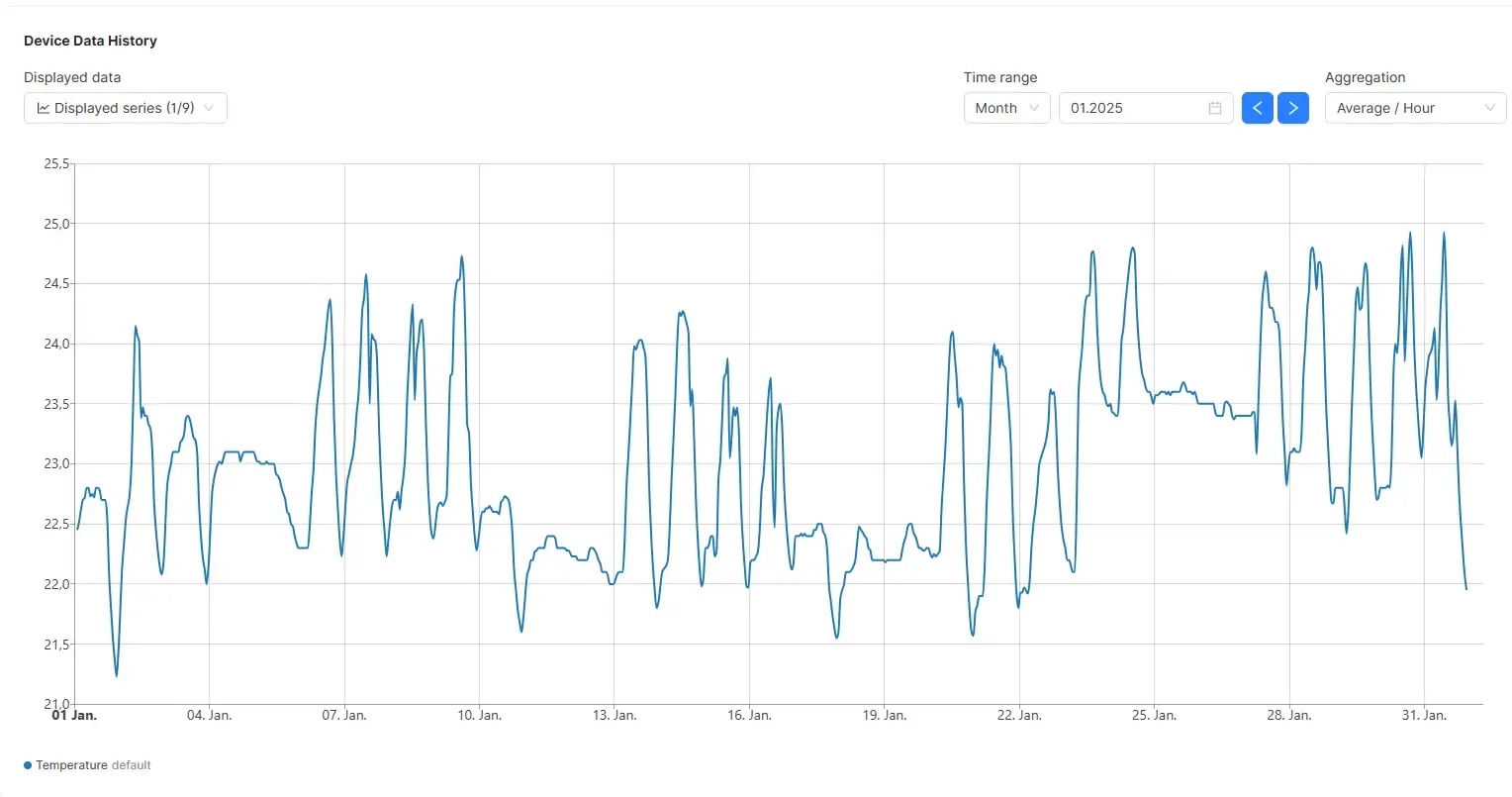
Temperature, vibration, pressure, humidity, power consumption, and fill levels are made measurable.
Sensors as a Data Source
Sensors form the interface between the real-world process and digital analysis.
The foundation for all further IoT steps
Without reliable data acquisition, monitoring, analysis, and automation are not possible.
Which data sources are relevant in the IoT
Machine and plant data
These include, for example, operating states, runtime, vibrations, or process parameters.
Environmental data
These include temperature, humidity, CO₂, particles, noise, or other environmental values.
Energy and consumption data
Electricity, gas, water, and other consumption metrics are important IoT data sources.
Condition and diagnostic data
This data provides indications of wear, deviations, or potential malfunctions.
Which sensors are typically used
Temperature sensors
They measure heat generation in machines, rooms, or processes.
Vibration and oscillation sensors
They are particularly relevant for condition monitoring and predictive maintenance.
Pressure, Level, and Flow Sensors
These sensors are frequently used in production, utility, and media processes.
Environmental and quality sensors
They measure factors such as air quality, humidity, particles, or other environmental conditions.
Energy meters and measurement modules
They provide transparency regarding consumption and load profiles.
What Makes for Good Data Acquisition
Relevance
Not every measured value is automatically meaningful. What matters is whether the data provides a concrete benefit.
Reliability
Sensors and measurement systems must operate precisely, stably, and robustly.
Context
A single measurement value often says little on its own. Meaning only emerges when viewed in context.
Availability
The data must be available in sufficient quality and at an adequate frequency to be usable.
How Sensor Technology Is Integrated into IoT Solutions
Data Collection at the Source
Measurements are taken directly at the machine, facility, or in the surrounding environment.
Transmission to Digital Systems
The data is transmitted to local or central systems.
Processing for Analysis and Visualization
Raw data is structured and made usable for dashboards or evaluations.
Typical Challenges in Practice
Incorrect Sensor Selection
Not every sensor is suitable for every environment or use case.
Lack of Context
Without process knowledge, data is often difficult to interpret.
Unclear Objectives
Those who do not know why they are measuring often collect too much data or the wrong data.
Interfaces and Integration
Sensor technology must be capable of being integrated into existing systems.
Role of Data Collection in the Overall IoT Model
Data collection is not an end in itself, but rather the starting point for many other applications. Only with good sensor technology do monitoring, optimization, maintenance, and scaling become possible in the first place.
Foundation for Monitoring
Only data that has been collected can be monitored and compared.
Foundation for Analysis
Predictive maintenance and condition monitoring require reliable input data.
Basis for Decisions
Management, engineering, and maintenance can only operate with robust data.
Role of the IoT System Provider in the Context of Data Collection and Sensor Technology
An IoT system provider helps select the appropriate sensors and integrate them effectively into the overall architecture.
Selecting the Right Measurement Points
It is not the number of sensors that matters, but their relevance.
Integration into Existing Systems
Data acquisition must fit into the environment both technically and organizationally.
Considering Scalability
Even at the initial acquisition stage, it should be clear how the solution can be expanded later.
Conclusion
IoT data acquisition and sensor technology form the technical foundation of industrial IoT solutions.